Daniel E. Doty
Ketchikan Superior Court | First Judicial District
Judge Doty was appointed to the Ketchikan Superior Court in March of 2022. This is his first judicial retention election.
Performance Summary
The Alaska Judicial Council finds that Judge Doty met or exceeded performance standards and recommends a "YES" vote for his retention in office.
This conclusion is based on surveys and reviews from attorneys, court employees, jurors, and other user groups familiar with the judge’s work, analysis of the judge’s financial disclosure documents, analysis of how often the judge’s decisions were affirmed on appeal, whether their pay was withheld for untimely decisions, how often the judge was disqualified from a case, whether the judge followed standards of ethical conduct and continuing education, input from the public, and the judge’s demonstrated commitment to the administration of justice and the community.
The Council’s evaluation process included an interview with Judge Doty, and an opportunity for Judge Doty to comment on his own performance.
“I have found this position to be enormously rewarding....I am so grateful that I have had the chance to help people resolve some of the most challenging disputes in their lives.”
- Judge Doty
Detailed Performance Findings
The Council evaluated Judge Doty’s performance on legal ability, integrity, impartiality and fairness, judicial temperament, and diligence and administrative skills. Judge Doty met or exceeded the standard in each of these areas.
A summary of the Council’s findings on Judge Doty’s performance is presented here. Full reports are posted in the source documents below.
-
▼ Legal Ability
Did the judge demonstrate knowledge of substantive law, evidence and procedure, and clarity and precision in their work?
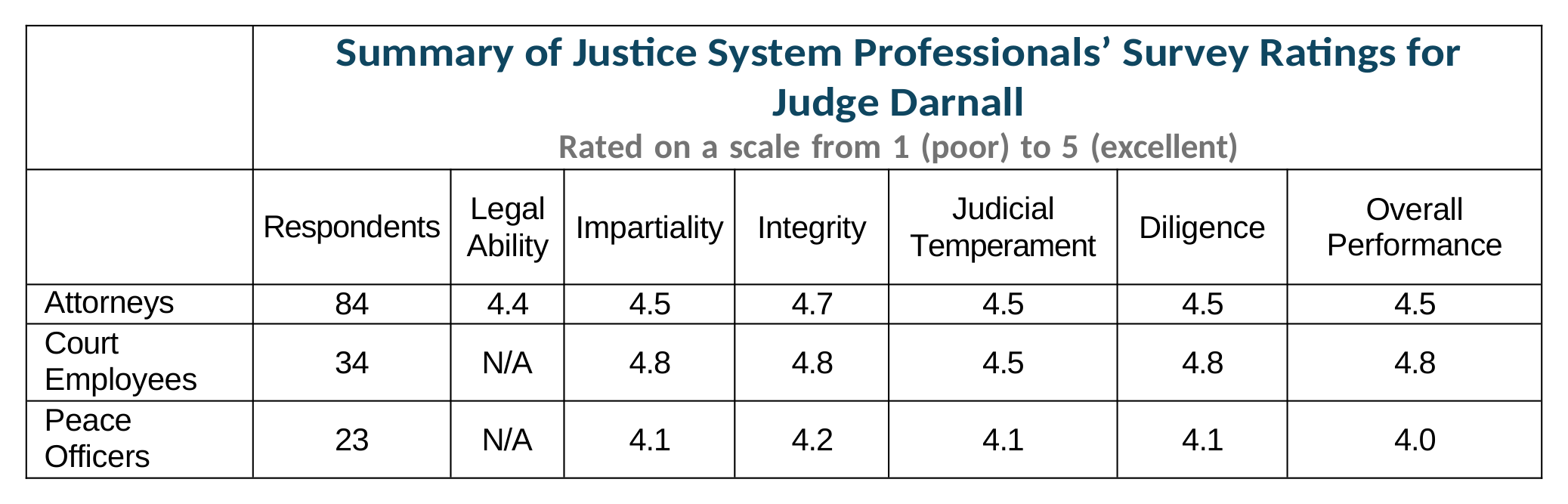
Attorneys familiar with Judge Doty’s work rated his legal ability as excellent. See chart below for numerical ratings. Attorneys who appeared in cases before him gave positive reviews.
Jurors who served in Judge Doty’s courtroom rated his attentiveness, intelligence and skill as excellent.
In Alaska, a party who disagrees with a trial judge’s decision can appeal to a higher court. The appeal court analyzes the judge’s decision and issues an opinion. The Council reviews all the opinions and analyzes how often and why individual judges are affirmed or reversed as one measure of the judge’s legal ability. Judge Doty had five cases appealed and decided in the evaluation period, with an affirmance rate of 76% (Good). A review of the opinions raised no concerns about his legal ability. For more details, see the Appellate Affirmance Report, linked below.
Judge Doty met or exceeded educational requirements set by the Alaska Supreme Court.
-
▼ Impartiality & Fairness
Did the judge demonstrate a sense of fairness and justice and treat all parties equally?
Attorneys and court employees rated Judge Doty’s impartiality and fairness as excellent. Peace and probation officers rated him as acceptable. See chart below for numerical ratings.
Jurors who served in Judge Doty’s courtroom rated his impartiality as excellent. See chart below for numerical ratings.
Court rules allow a litigant at the beginning of a case to file a request for change of judge. Parties whose cases were assigned to Judge Doty seldom asked for a different judge.
-
▼ Integrity
Was the judge's conduct free from impropriety or the appearance of impropriety, and did the judge make decisions without regard to possible public criticism?
Attorneys and court employees rated Judge Doty’s integrity as excellent. Peace and probation officers rated him as acceptable. See chart below for numerical ratings.
Judge Doty filed financial disclosure statements with the Alaska Public Offices Commission and separate conflict-of-interest forms with the court system as required, and the Council found no items of concern in these disclosures.
The Council confirmed that Judge Doty was not the subject of any public disciplinary proceedings before the Alaska Commission on Judicial Conduct, and that he followed standards of ethical conduct for judges.
Judges must disqualify themselves from cases where they have a conflict of interest or their impartiality might reasonably be questioned. The Council found no concern about Judge Doty’s performance on this requirement.
-
▼ Judicial Temperament
Was the judge courteous and free from arrogance, and did the judge manifest human understanding and compassion?
Attorneys and court employees rated Judge Doty’s judicial temperament as excellent. Peace and probation officers rated him as acceptable. See chart below for numerical ratings.
Jurors who served in Judge Doty’s courtroom rated him excellent on respectful and courteous behavior.
-
▼ Diligence & Administrative Skills
Was the judge prepared for court proceedings, did the judge work diligently, and was the judge reasonably prompt in making decisions?
Attorneys and court employees rated Judge Doty’s diligence and administrative skills as excellent. Peace and probation officers rated him as good. See chart below for numerical ratings.
Under Alaska law, a judge cannot receive a paycheck if they have any decision undecided or uncompleted for more than six months. Each pay cycle, judges must sign an affidavit declaring that no matter referred to them has remained undecided or uncompleted for more than six months. The Council verified that Judge Doty was paid on schedule, and he certified that he had no untimely decisions.
Judge Doty demonstrated commitment to improving the administation of justice and to community outreach. Judge Doty:
- Serves on the court system’s Criminal Rules Committee, a group that drafts, reviews, and recommends improvements in criminal case procedures to the Alaska Supreme Court;
- Serves on a special court system workgroup to improve timely case processing;
- Serves on the Judicial Conference Planning Committee, a group that plans the court system’s annual conference for judges;
- Serves as a Commissioner to the National Commission on Uniform State Laws, where he is helping to incorporate the federal Indian Child Welfare Act into state law;
- Visited local schools;
- Made an educational presentation at a local rotary club about judicial selection and independence; and
- Submitted an opinion piece to a local newspaper on the judge’s role and the separation of powers in bail and sentencing.
See Judge Doty's retention questionnaire for more information.
The Judicial Council distributed electronic surveys to attorneys, court employees, and jurors asking them to rate Judge Doty's performance on key skills. Survey ratings from these groups are shown in the charts below.
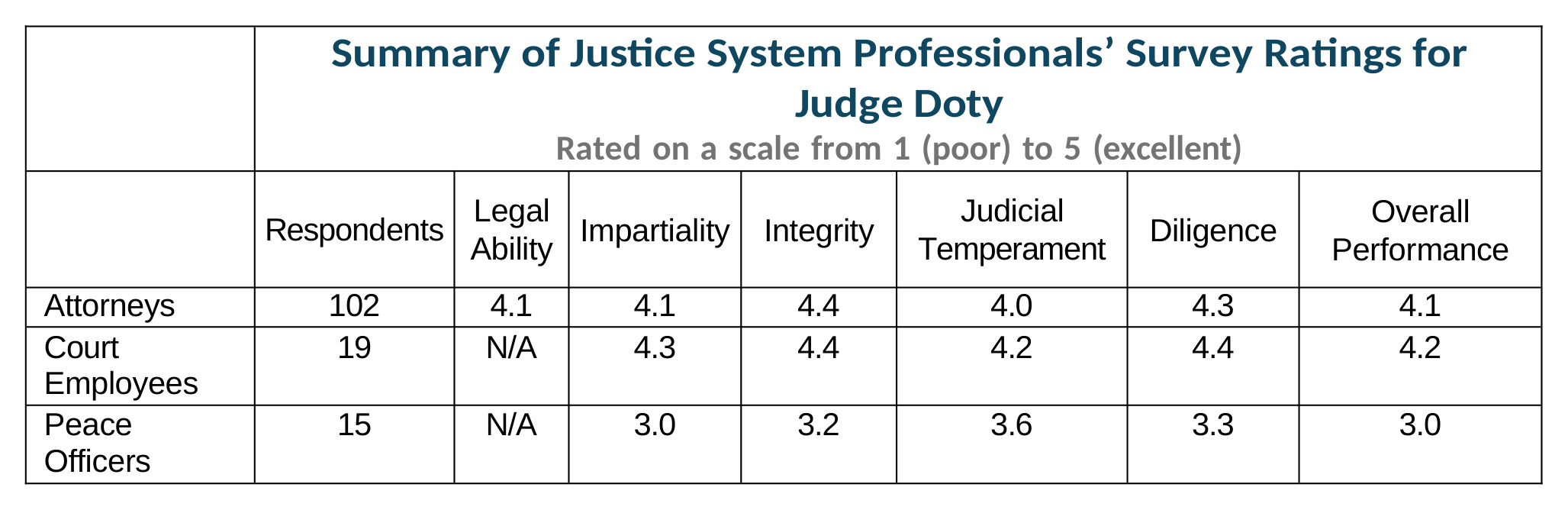
The Judicial Council distributed surveys to jurors who sat for trials in Judge Doty’s courtroom. The jurors’ survey ratings are below.